















TL;DR
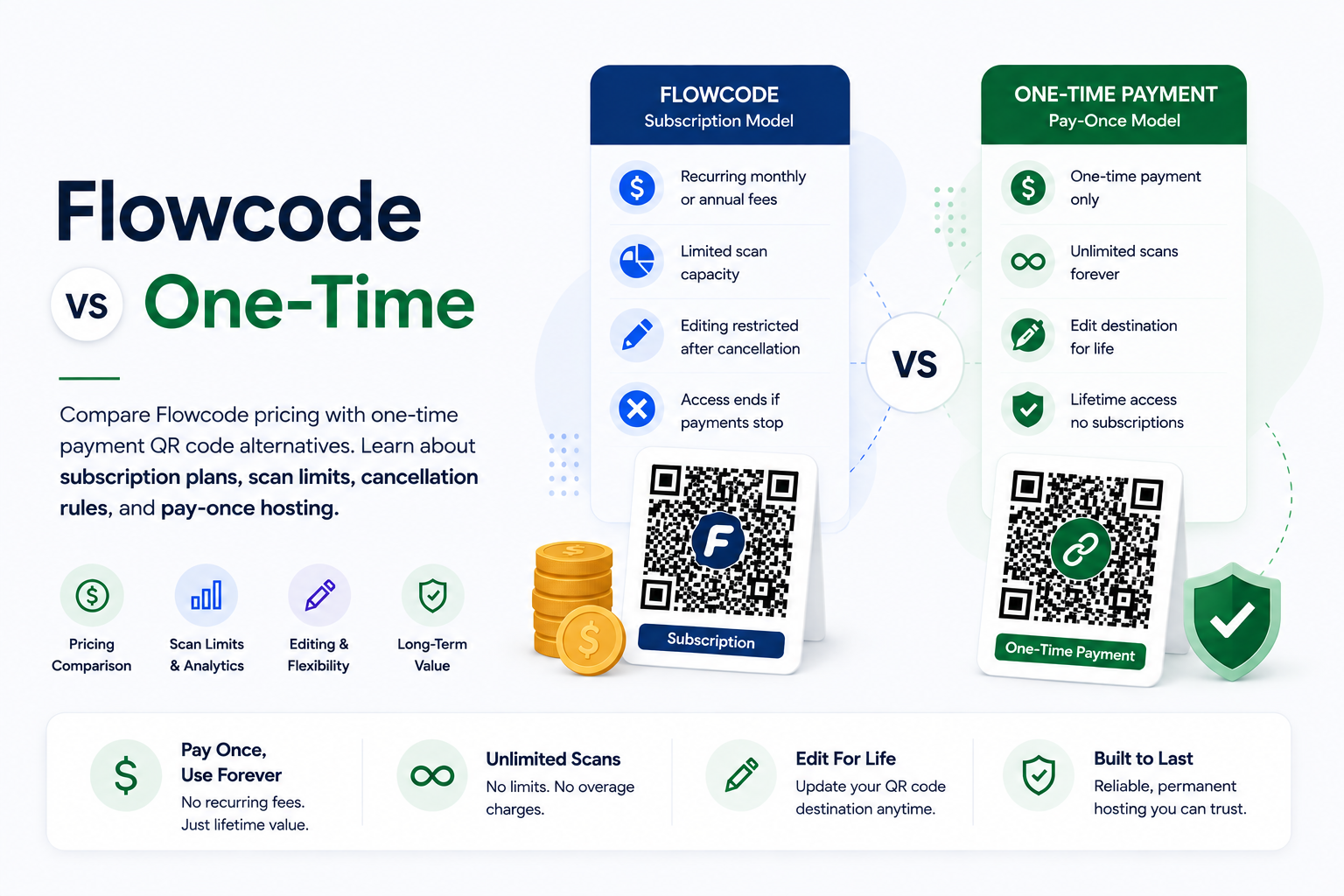
- ·Flowcode requires a paid subscription (roughly $25-60/mo Pro Plus, ~$250/mo Growth) beyond 2 dynamic codes, vector exports, or team features.
- ·Canceling doesn't kill existing codes, but only your 2 most recent stay editable; older codes freeze at their last destination.
- ·Subscription tiers cap scan volume (e.g. 5,000/mo on Pro Plus) with overage fees beyond that.
- ·A one-time-payment alternative ($49) keeps permanent destination editing and unlimited scans without a recurring bill.
- ·The printed code itself doesn't change between these models; only the payment structure behind the redirect differs.
When marketing teams, product designers, and business owners evaluate QR code platforms, Flowcode is frequently on the shortlist. With its distinctive circular designs, landing page builder, and conversion tracking, it has established a prominent presence in direct-to-consumer marketing. However, as teams move from quick promotional experiments to permanent physical print assets—such as product packaging, author books, industrial tags, and long-term signage—the question of ongoing cost becomes critical.
If you are researching Flowcode pricing vs one-time payment solutions, you need clear facts: how the recurring subscription model operates, what happens if you decide to cancel, and whether a Flowcode alternative with no subscription can deliver dynamic flexibility without an ongoing software bill. This guide breaks down Flowcode's verified pricing plans, analyzes the long-term total cost of ownership, and compares subscription-based QR management with one-time payment permanent QR hosting.
01 Quick Answer: Flowcode Pricing vs One-Time Payment
How Do They Compare?
Flowcode uses a subscription-based SaaS model for its dynamic QR management and marketing features, while a one-time payment QR solution uses a pay-once commercial model.
MODEL COMPARISON:
- Flowcode Subscription-based platform. Dynamic QR management and advanced marketing/analytics features depending on the plan.
- One-Time Payment Pay once. No recurring subscription for the offered model. Designed for long-term printed assets.
- Best Fit Flowcode is best for campaign-focused marketing workflows; the one-time model is best for long-term physical print assets.
02 What Is Flowcode?
Flowcode is a direct-to-consumer QR code and consumer engagement platform founded by former AOL CEO Tim Armstrong. Unlike standard open-source square QR generators, Flowcode centers its product around proprietary circular QR code templates, integrated mobile landing pages (Flowpages), real-time scan analytics, and customer relationship management (CRM) connections.
Flowcode is primarily tailored for brand marketing campaigns, direct-response television advertisements, live event engagements, and omnichannel customer data collection. Its tools are designed for dynamic campaigns where marketers frequently build customized mobile pages and sync scan interactions into downstream marketing automation platforms.
03 Flowcode Pricing Breakdown
Flowcode structures its platform as a Software-as-a-Service (SaaS) subscription with tiered feature packages. Based on Flowcode's published pricing plans, here is how the pricing tiers are structured:
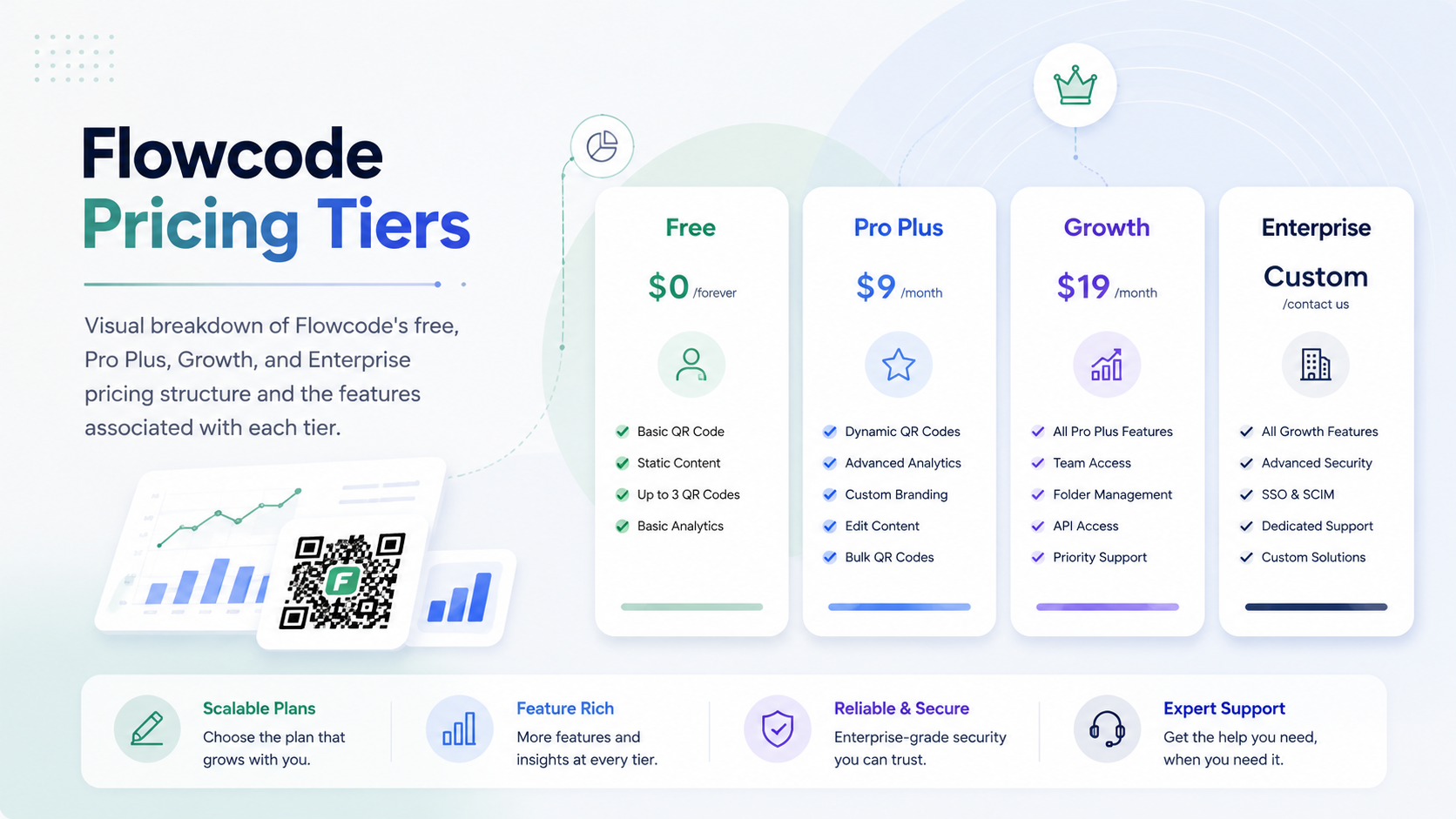
$0 / month
Designed for testing. Includes up to 2 active dynamic Flowcodes in your dashboard and basic scan tracking capped at introductory scan volume limits (typically 200 to 500 scans). Advanced features like team collaboration, custom domains, and vector downloads are restricted.
Pro Plus Plan
~$25 / month billed annually
Or ~$60 / month on month-to-month billing ($720/year)
Primary self-serve tier. Billed upfront at ~$300/year. Expands account capacity to up to 50 active Flowcodes, includes 3 collaboration seats, and raises scan tracking limits up to 5,000–6,000 scans per month.
Growth Plan
~$250 / month billed annually
Billed upfront at ~$3,000/year
Includes up to 150 Flowcodes and landing pages, adds detailed geographic scan attribution data, and introduces CRM integrations and developer API access.
Enterprise Plan
Custom pricing
For global consumer brands. Includes unlimited codes, custom redirect subdomains, dedicated customer success management, single sign-on (SSO), and custom customer data platform (CDP) integrations.
*Note: Pricing and tier limits details are based on published Flowcode documentation and pricing pages as of current records, and are subject to change. Please verify current pricing directly with official sources.
04 Does Flowcode Require a Subscription?
Yes. Flowcode operates fundamentally under a Software-as-a-Service (SaaS) subscription model. While the platform offers a free entry-level plan for up to 2 codes, any business that requires more than 2 dynamic QR codes, team collaboration, elevated scan tracking limits, or advanced reporting must maintain a monthly or annual paid subscription.
Because dynamic QR codes rely on redirect servers to forward scanners to your destination URL, the ongoing maintenance of that dashboard and redirect infrastructure is funded through these recurring subscription fees.
05 What Happens When You Stop Paying for Flowcode?
A key consideration is whether dynamic QR codes automatically stop working or "expire" if a subscription is canceled. Based on Flowcode's published support documentation, Flowcode operates a specific downgrade protocol when a paid subscription ends:
Dashboard Access Reduced to 2 Codes
When you cancel a paid plan and the billing period ends, your account downgrades to the free tier. In your management dashboard, you retain destination-editing and management access for only the 2 most recent Flowcodes you created.
Older Printed Codes Continue to Scan
According to published Flowcode documentation, previously created codes beyond the 2 free slots will continue redirecting users to the last destination URL assigned before cancellation. They do not automatically expire or redirect to a broken page.
Loss of Destination Editing for Older Codes
This is the critical distinction: while the code continues to scan, you cannot edit, update, or redirect its destination URL in the dashboard without re-subscribing. This locks the destination permanently unless you pay again.
Scan Analytics Revert to Free Limits
Analytics tracking for your active codes is reduced to free tier caps (such as 200–500 scans), and historical Pro-level metrics and CSV export features are deactivated.
Deactivation of Premium Features
Custom mobile landing page modules, team collaboration seats, and advanced integrations (such as CRM or CDP sync) are deactivated when the paid subscription ends.
06 Flowcode vs One-Time Payment QR Codes
To evaluate whether a subscription SaaS platform like Flowcode or a pay-once model fits your needs, it helps to compare them across core features and billing structures:
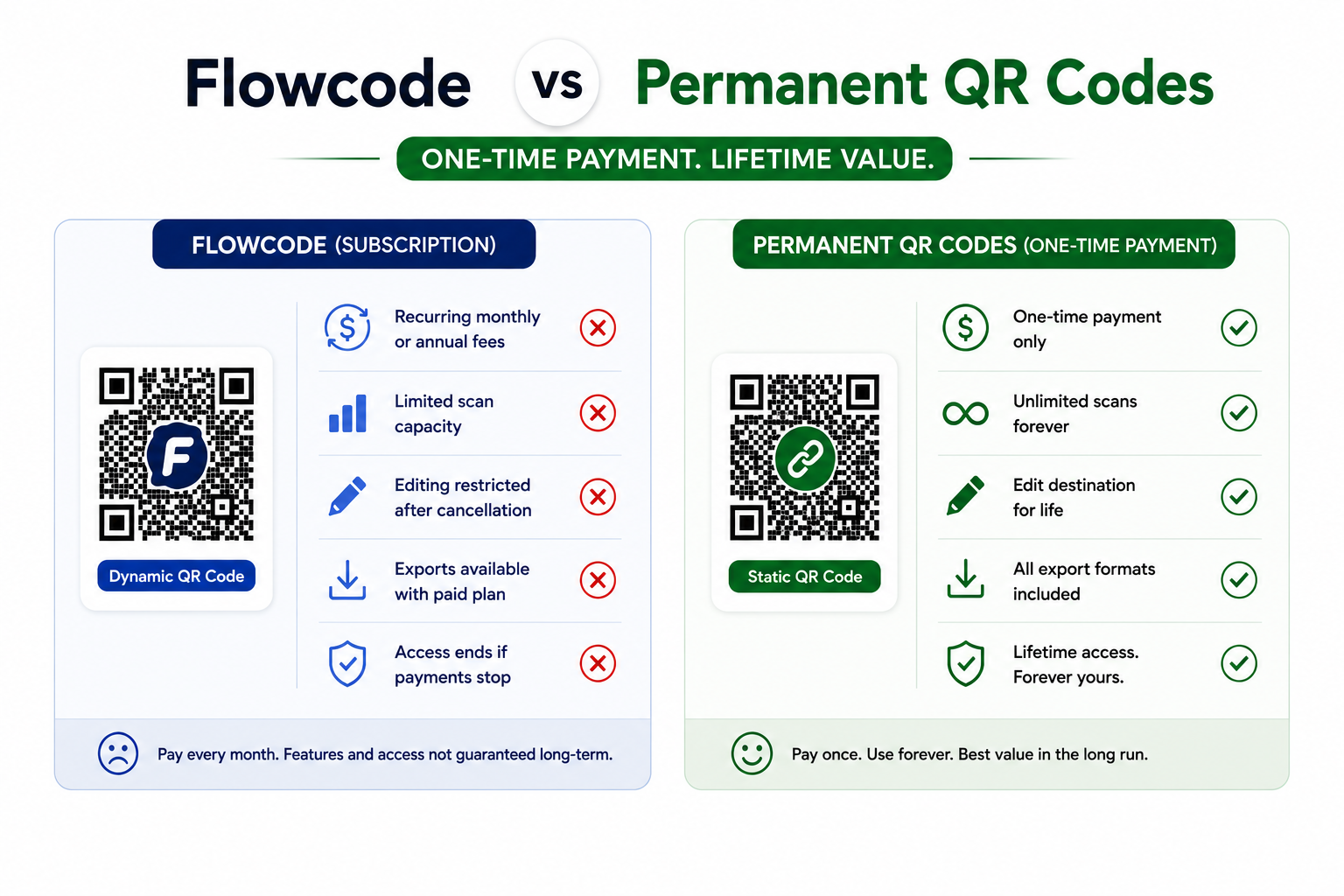
| Comparison Dimension | Flowcode (Pro Plus Plan) | PermanentQRCodes (Pay-Once Model) |
|---|---|---|
| Pricing Model | Recurring SaaS subscription (~$25/mo annual or ~$60/mo monthly) *Based on published pricing/documentation | One-time payment ($49 single code; bulk rates down to $10) |
| Subscription Requirement | Yes (Recurring monthly or annual fee) | No recurring subscription ($0/month forever) |
| Long-Term Cost (5 Years) | 1 Code: $1,500 (annual) or $3,600 (monthly) 5 Codes: $1,500 (annual) or $3,600 (monthly) *Examples based on stated annual and monthly Pro Plus fees | 1 Code: $49 one-time payment 5 Codes: $199 bundle one-time payment *Calculations based on standard single and bundle rates |
| Destination URL Editing | Included while subscription remains active | Included for life on every code in dashboard |
| Editing After Cancellation | Restricted to 2 most recent codes only *Based on published support documentation | N/A — No subscription to cancel; permanent access |
| Scan Limits | Capped per tier (e.g., typically 5,000–6,000/mo on Pro Plus) *Feature availability depends on plan | Unlimited scans forever with zero overage charges |
| Vector Exports | Included with paid subscription *Feature availability depends on plan | Included with all codes (PNG, SVG, PDF, EPS) |
| QR Format/Design | Proprietary circular designs & standard codes | Standard ISO/IEC 18004 universal matrix |
| Best Application | Campaign-focused marketing, Flowpages, TV ads | Physical packaging, books, signage, equipment tags |
Long-Term Cost Comparison Example
To understand the long-term total cost of ownership, let's look at a clear mathematical example over 5 years. This calculation compares the cost of maintaining active redirect destinations under both models:
~$1,500 to ~$3,600 total
Based on published Pro Plus pricing of $25/month billed annually ($300 × 5 years = $1,500) or $60/month billed monthly ($720 × 5 years = $3,600).
$49 to $199 total
A single code costs $49 one-time. A bundle of 5 codes costs $199 one-time. There are $0 recurring software subscription fees.
*Note: These calculations serve as transparent examples based on published pricing at the time of writing. Savings will vary depending on your specific requirements and deployment scale.
07 Flowcode Alternative With No Subscription
For organizations seeking a Flowcode alternative with no subscription, Permanent QR Codes provides a transparent pay-once commercial model. Instead of paying recurring monthly or annual SaaS fees to keep your dynamic QR redirection active, you purchase a dynamic QR code license once and own it for the long term.
Permanent QR Codes uses a pay-once model for its dynamic QR offering, subject to the service's current terms. The dynamic redirect infrastructure is designed for high reliability and long-term asset management. Key features of this offering include:
- · Pay-Once Licensing: A single payment of $49 per code (with volume discounts down to $10/code) grants long-term dynamic redirect hosting under our service terms.
- · Continuous Destination Editing: Log into your management dashboard at any time to redirect the QR destination URL, without altering or reprinting the printed physical symbol.
- · Unlimited Scan Capacity: No monthly scan tracking limits, throttling, or overage charges under the standard service offering, regardless of scan volume.
- · High-Resolution Vector Formats: Download standard-compliant vector formats (SVG, PDF, EPS) alongside PNG files for lossless scaling in commercial printing and engraving.
- · Flexible Pricing for Teams: Multi-SKU product deployments or agency campaigns can leverage automatic volume-tiered pricing on our Bulk QR Code Pricing page.
08 Who Should Choose Each Option?
Choosing the right QR code framework depends on your specific campaign lifecycle, design preferences, and long-term software budgeting requirements.
Flowcode may be a strong fit if:
- You require proprietary circular brand designs to align with creative guidelines.
- You need built-in mobile landing pages (Flowpages) hosted directly on the QR platform.
- You run TV or omnichannel broadcast campaigns requiring enterprise-level tracking.
- You require active real-time integrations with enterprise CRMs and CDPs.
One-time payment may be a strong fit if:
- The QR code will remain physically deployed on print assets for a long period.
- Accumulating recurring software overhead for simple URL redirects is undesirable.
- You want high-resolution standard vector files (SVG/PDF/EPS) for commercial print.
- You want unlimited scan capacity without monthly limits or overage penalties.
Common Print Scenarios
These six typical before-and-after scenarios show how physical durability and digital redirect architecture interact over time:
Product Packaging & Labels
Common Scenario: A manufacturer prints a barcode on packaging that remains in storage or retail distribution channels for months or years. The destination URL must remain active throughout the product's entire lifecycle.
What can go wrong: If a recurring subscription lapses, redirect links on packaging may fail. Static links cannot be updated if destination URLs change post-print.
Recommended Approach: A pay-once dynamic model ensures redirect URLs remain active long-term under current terms, allowing editing if target resources move, without reprinting costs.
Books & Publications
Common Scenario: A printed book, textbook, or academic work is in circulation for a decade or longer. Once printed, the physical barcode cannot be altered, and redirect hosts must remain functional.
What can go wrong: Publishers changing web servers years down the line can break static URLs. Discontinuing monthly billing on dynamic platforms renders old books unredirectable.
Recommended Approach: A permanent dynamic model with permanent hosting redirects scans indefinitely under service terms, meaning links can point to new websites years after printing.
Industrial Equipment Tags
Common Scenario: A machinery placard or asset tag links to safety manuals and repair documentation. The tag is exposed to grease, abrasion, UV rays, and cleaning agents for the machine's operational lifespan.
What can go wrong: Standard paper tags degrade rapidly. Changing the company CMS breaks old static code manuals, and subscription fees for basic redirect assets add ongoing IT line items.
Recommended Approach: Pair laser-etched metal tags (Level H error correction) with a pay-once dynamic model to guarantee physical readability and digital redirection editing without recurring SaaS costs.
Commercial Signage & Billboards
Common Scenario: Exterior building signage or retail displays feature a large QR code. Replacing these physical signs is highly expensive and labor-intensive.
What can go wrong: If the destination page moves and the QR is static, the physical sign becomes useless. A recurring subscription is an unnecessary billing risk for standard signs.
Recommended Approach: A pay-once dynamic model allows for changing target landing pages whenever branding or promotions update, protecting the physical signage investment.
Real Estate Yard Signs
Common Scenario: Agents print dynamic QR codes on reusable yard signs. Each time a sign is placed at a new listing, the QR code must point to the new listing page.
What can go wrong: Over years of reuse, seasonal subscription lapses render sign redirects uneditable or broken. Printing static codes requires a new batch of signs for every property.
Recommended Approach: A pay-once dynamic model permits updating destination URLs for each listing. The printed sign stays active and editable year after year, with zero billing risks.
Restaurant Table Menus
Common Scenario: Table tents or window decals link to an online menu. Menu items and prices change seasonally, and table tents suffer grease and spills.
What can go wrong: If static QR codes are printed on decals, seasonal edits require reprinting decals. A recurring subscription model adds a fixed monthly fee to operating expenses.
Recommended Approach: Laminate the menu signs to protect them physically, and use a pay-once dynamic QR model to update the target PDF or menu webpage menu without reprinting or recurring fees.
FAQ & Clarifications · 09
Frequently Asked Questions
Answers to common questions about Flowcode pricing structures, billing, cancellation behaviors, and subscription-free alternatives.
Does Flowcode require a subscription?
Yes, based on Flowcode's published pricing, managing more than 2 dynamic codes, accessing vector exports, or utilizing team features requires an ongoing monthly or annual paid subscription (such as the Pro Plus tier starting at approximately $25/month when billed annually).
How much does Flowcode cost per year?
Flowcode's Pro Plus plan costs approximately $25 per month when billed annually ($300/year upfront) or approximately $60 per month on month-to-month billing ($720/year). Their Growth tier is priced at approximately $250 per month billed annually ($3,000/year), based on published documentation.
Do Flowcode QR codes expire if I cancel?
No. According to published Flowcode support documentation, existing QR codes do not automatically expire or stop scanning when you cancel a paid subscription. They will continue to redirect scanners to the last destination URL assigned before downgrade.
What happens after cancellation?
Upon cancellation of a paid plan, the account is downgraded to the free tier. You retain the ability to edit and manage destination URLs only for the 2 most recent codes in your dashboard. Older codes remain active and will scan, but their destination URLs cannot be updated without renewing a paid subscription.
What is a Flowcode alternative with no subscription?
Permanent QR Codes is a pay-once alternative. Instead of paying recurring monthly or annual SaaS fees, you pay a single one-time payment starting at $49 (with bulk discounts) to create a dynamic QR code that features permanent destination editing and unlimited scans under current terms.
Can I edit a QR code destination with a one-time payment?
Yes. With a one-time payment dynamic QR code from Permanent QR Codes, you can log into your management dashboard at any time to update the destination URL. The physical QR code printed on your assets remains the same and does not need to be recreated.
Are scan volumes limited?
While Flowcode and other subscription-based platforms typically cap scans per tier (such as 5,000 scans per month on Pro Plus) or charge overage fees, Permanent QR Codes provides unlimited scans forever with no scan limits, throttling, or monthly scan fees.
This pricing and commercial comparison is compiled from official documentation, published plan terms, and pricing schedules provided by each service provider. Authoritative references used in this guide include:
- Flowcode Pricing Plans: Stated features, seats, and scan limitations are sourced from official published plans and commitments on the Flowcode Pricing Page.
- Flowcode Cancellation Behavior: Downgrade conditions, dashboard slot restrictions, and code redirect permanence upon subscription cancellation are sourced from official documentation in the Flowcode Help Center.
- Permanent QR Codes Pricing: Commercial dynamic QR hosting terms, volume discounts, and vector file export features are sourced directly from the Permanent QR Codes Pricing Page and current customer service agreements.
*Editorial Note: Pricing and feature information in this comparison should be checked against the provider's current published terms, as plans and features may change.
About the Author
Gayatri G
Founder of Permanent QR Codes. Writes about QR codes for long-life print: packaging, vector print specifications and durable equipment tags.