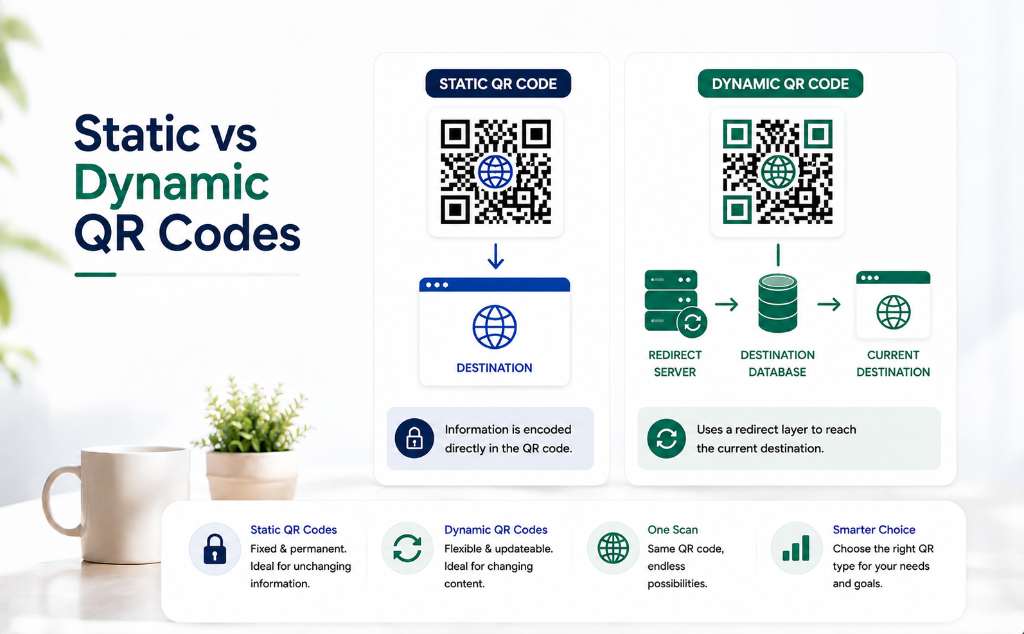
When launching a campaign, printing product packaging, or putting up physical signage, the choice between static and dynamic codes is a fundamental architectural decision. Selecting the wrong format can lead to uneditable broken links, overly dense unreadable symbols, or unexpected service interruptions after distribution.
While both formats look identical as black-and-white 2D grids, they operate on different data principles. A static code encodes its destination directly into the physical pattern, whereas a dynamic code links to a routing gateway that routes visitors to the final destination.
01 Quick Answer: Static vs Dynamic QR Codes
Fundamental Difference
Where Data Is Stored
Static codes store the encoded data directly in the QR symbol. Dynamic codes store a routing URL that can lead to a changeable destination.
Architectural Overview:
- Static • Destination encoded directly • Cannot edit encoded data after printing
- Dynamic • Uses a redirect/routing layer • Destination can be changed through the provider
- Permanent Dynamic • Permanent QR Codes' specific pay-once offering • Destination management according to current service terms
02 What Is a Static QR Code?
A static code is a direct, self-contained data container defined by the open ISO/IEC 18004 standard. When you generate a static code, the system takes your exact alphanumeric input—such as a website URL, Wi-Fi network credentials, or plain text—and translates it directly into binary modules using standard encoding modes developed by DENSO WAVE.
How Static QR Codes Work
When a camera or optical reader scans a static symbol, the device decodes the module grid entirely client-side. A static QR code does not provide an editable destination layer through the QR generator itself. The encoded data remains unchanged after printing.
However, the final destination page itself can still perform redirection (such as a server-side redirect setup on your own domain). The printed symbol itself has a fixed destination string baked into its ink.
Advantages of Static QR Codes
Because there is no intermediary server hosted by the QR generator that can shut down or lapse, static symbols remain functional indefinitely as long as your destination website remains live.
No Ongoing Service Fees
Static codes can be created without a recurring QR service, making them useful for personal use, offline credentials, and simple URL links.
Offline Compatibility
Static symbols can encode plain text, Wi-Fi credentials, or contact cards (vCards) that work entirely offline without requiring active internet connectivity.
Limitations of Static QR Codes
Unchangeable Encoded Data Payload
The visual pattern is mathematically fixed. If the target URL contains a typo or its site structure changes, you must reprint every physical copy.
High Module Density for Long URLs
Longer URLs with search parameters require higher QR version modules (e.g. Version 10 or 20 instead of Version 2). This creates a dense, complex grid that is difficult for cameras to scan from a distance or in poor lighting.
No Native Scan Analytics
Because scans do not pass through a generator redirect gateway, you cannot track real-time scan volumes, user locations, or device types (unless using tracking parameters on your own destination server).
03 What Is a Dynamic QR Code?
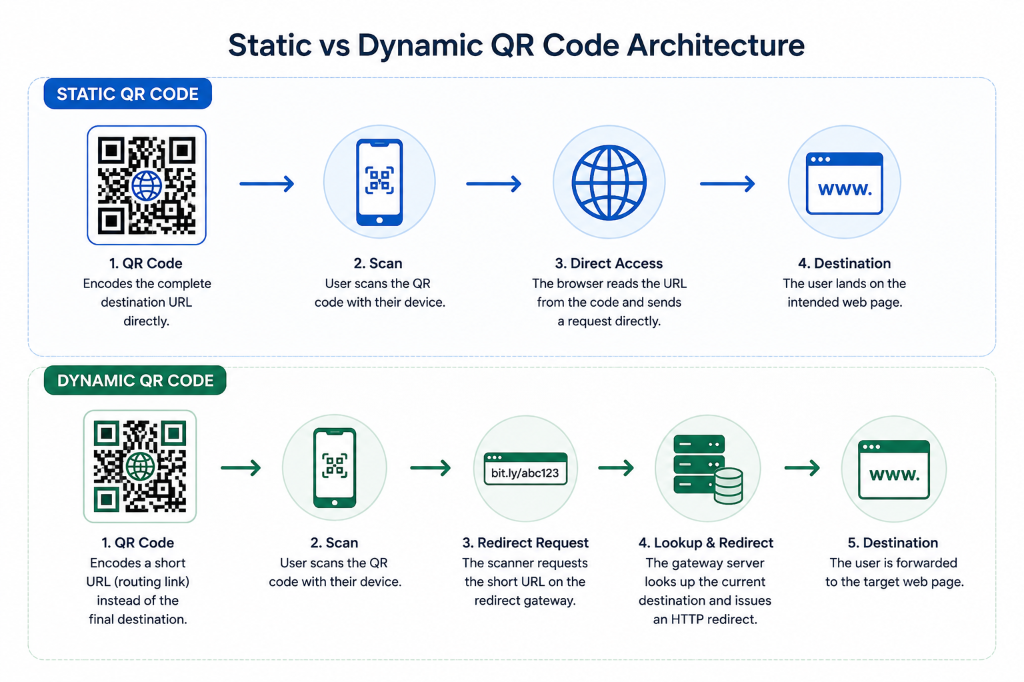
A dynamic code introduces a routing layer between the printed symbol and the final destination. Instead of baking a lengthy final URL into the image, the generator encodes a compact short routing link.
How Dynamic QR Codes Work
When a user scans a dynamic code, the interaction follows a routing path: the scanner requests the short URL hosted on the redirect gateway, and the gateway server looks up the current destination in its database, issuing an HTTP redirect to forward the browser to the target web page.
Advantages of Dynamic QR Codes
Editable Destination Post-Print
You can update the target destination URL or redirect location in your dashboard anytime without altering or reprinting the physical code.
Clean, Low-Density Matrix
Because the encoded short routing link is compact, the symbol remains clean and simple. This low-density grid scans rapidly even at small print sizes or from steep angles.
Scan Analytics and Optimization
Depending on the provider, dynamic QR services may log scan timestamps, geographic regions, device operating systems, and traffic volume in real time. Some services also offer A/B testing and scheduling features.
Limitations and Service Dependencies
Operational Redirection Dependency
A dynamic code depends entirely on the server hosting the redirect layer. If the provider's server experiences downtime, the scan fails to reach the destination page.
Subscription Risk
Some dynamic QR services use recurring subscription pricing, so review the provider's pricing and service terms before printing at scale. If you cancel your subscription or payments lapse, the redirect layer may be disabled.
04 Static vs Dynamic QR Codes: Key Differences
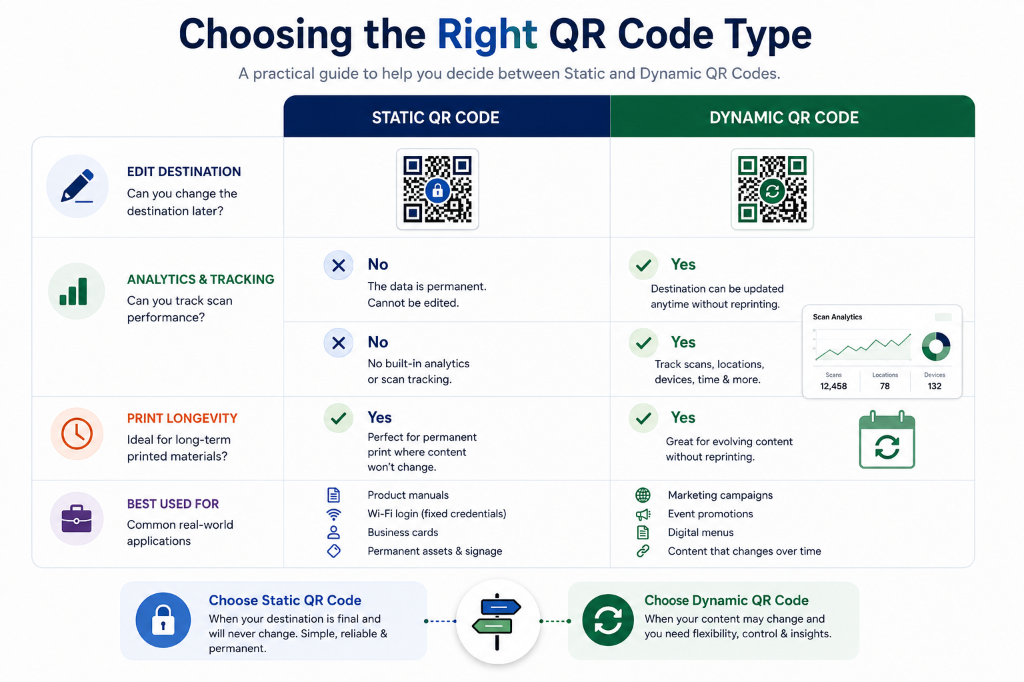
To help you evaluate which architecture fits your print workflow, the table below compares technical characteristics, operational control, and long-term considerations:
| Factor | Static QR Code | Subscription Dynamic | Permanent Dynamic |
|---|---|---|---|
| Destination Editing | No (Hardcoded in symbol) | Yes (In dashboard) | Yes (In dashboard) |
| Encoded Data | Direct final URL / text payload | Intermediary short routing link | Intermediary short routing link |
| Matrix Density | High (Expands with input length) | Low & Clean (Fixed routing link) | Low & Clean (Fixed routing link) |
| Analytics | None (Direct resolution) | Real-time (Depends on provider) | Real-time (Depends on provider) |
| Service Dependency | None (Air-gapped) | High (Depends on active subscription) | Depends on redirect layer provider |
| Cost Structure | Free to generate | Recurring monthly or annual fees | Pay-once model |
| Lapsing / Expiration Risk | Static code itself does not depend on a QR subscription, but a URL destination can stop working if the website or resource is removed. | High (Redirect disables if subscription lapses) | Low (No recurring subscription to lapse, subject to provider terms) |
| Best Applications | Fixed Wi-Fi, offline text credentials | Short-term digital promotions | Product packaging, books, signage, tags |
Looking for a pay-once model for editable codes? Skip recurring subscription risks.
See Pricing →05 Can You Change a QR Code After Printing?
Whether a printed code can resolve to a new destination depends on how it was originally generated:
With a static code, you cannot edit the encoded data within the symbol pattern. However, if the code points to a URL on a domain you control, you can implement a server-side redirect (such as an HTTP 301 Permanent Redirect on your web server, configured via Apache's Redirect directive or NGINX's return directive) to forward visitors to a new target page. If the printed URL contains a typo in the domain itself, the code is unrecoverable and must be reprinted.
With a dynamic code, you can log into your management dashboard and update the destination URL instantly. The printed symbol remains unchanged because it continues pointing to the same routing link. For more details on editing printed codes, read our detailed guide on how to edit a QR code after printing.
06 Which QR Code Type Should You Choose?
Selecting the appropriate format depends on the lifespan of your physical asset, your distribution volume, and whether the destination content will evolve over time:
Choose Static QR Codes When:
You are sharing fixed, unchangeable details such as Wi-Fi credentials or an offline emergency contact card (vCard).
You require offline compatibility without depending on internet access or external routing servers.
You are printing short-run, temporary paper materials (such as flyers or single-day event handouts) where reprinting is trivial if a link breaks.
Choose Dynamic QR Codes When:
You are printing on high-value physical assets (such as product packaging, retail boxes, or durable asset tags) where a broken link would require SKU recalls or re-labeling.
You are installing permanent signage, vehicle wraps, or trade show booth displays.
You are publishing books, catalogs, or printed materials where digital resources may be reorganized over time.
You require real-time scan analytics to measure marketing performance and reach.
07 How Permanent QR Codes Fit Into the Decision
Traditionally, users had to choose between static codes (which are permanent and free, but completely uneditable) and dynamic codes (which offer destination editing, but depend on recurring monthly subscription bills to keep redirects active).
Permanent QR Codes addresses this tradeoff by offering a pay-once dynamic code model. The platform provides dynamic routing and destination editing without requiring monthly or annual subscriptions, subject to the service's current terms. The offering allows you to change the destination URL, monitor scan analytics, and export vector files (such as SVG, PDF, and EPS formats) for high-resolution print workflows.
Permanent QR Codes uses a pay-once model with no recurring subscription required for its offering, subject to the service's current terms. For more details on volume rates and options, visit the pricing page.
08 Real-World QR Code Scenarios
To understand how these principles apply in practice, look at these four common scenarios where printed codes are deployed.
A consumer goods manufacturer prints QR codes on thousands of retail product packages before distribution to regional warehouses. These printed codes link buyers to user guides, product registration pages, or dynamic support portals.
After the packaging run is completed and distributed, the product registration URL changes during a website overhaul, or a critical typo is discovered in the destination URL. If a static routing format was used, the printed code is permanently broken, potentially forcing a costly recall of retail boxes or requiring manually applied sticker overlays.
Implement a managed routing layer (dynamic routing) for all packaging designs. This ensures the physical barcode resolves to a short redirect URL under your control, allowing you to update the target user guide destination in the cloud database at any time without altering the physical packaging assets.
A dining establishment prints high-quality tabletop cards or laminated menus containing QR codes that redirect dining guests to their digital lunch and dinner menus.
Seasonal menu updates require shifting hosting locations, or the restaurant switches their menu hosting provider, which changes the target URL path. If the printed tabletop symbol has a hardcoded static link, every single physical menu card across all tables must be discarded, reprinted, and redeployed.
Generate a dynamic destination link. The physical printed barcode remains identical, pointing to the same routing layer, while menu path updates are handled dynamically in the backend dashboard, saving substantial recurring print costs.
A marketing team prints and distributes large-format posters, direct mail brochures, and outdoor campaign flyers to promote a seasonal festival or corporate launch, linking to ticket registration forms.
Before the campaign officially launches, the ticketing platform suffers service changes or registration deadlines shift, making the target URL obsolete. If static codes were printed, already-distributed physical promotional flyers will lead to a 404 error page, wasting the print campaign budget.
Set up dynamic routing for promotional print materials. The printed materials preserve the same visual code pattern, but the organizer can swap the ticketing redirect target or extend registration pages on the fly.
A facility manager applies laser-etched metal asset tags or durable vinyl labels containing QR symbols to high-value machinery. These codes link technicians directly to maintenance history, digital safety manuals, or inspection checklists.
Over the machinery's 10-to-20-year lifespan, the plant migrates its internal database or document management system to a new software vendor, changing all target document URLs. If the printed symbols encoded static URLs, the physical plates must be laser-etched and mounted again, which is expensive and labor-intensive.
Utilize dynamic codes with permanent redirect hosting. The durable metal labels stay securely in place on the equipment for decades, while any future server migrations or platform updates are managed by editing the redirect destination in the cloud.
Practical Takeaway
The choice between static and dynamic routing models depends on your deployment requirements. If you are sharing permanent, offline credentials that will never change, a static printed code is a reliable, serverless option. For commercial print runs, product packaging, and permanent signage where destination URLs may change or require tracking over time, a dynamic code with a managed routing layer is essential to avoid broken links and reprinting costs.
Sources & References
- DENSO WAVE — Inventor of the QR Code technology and provider of official technical specifications.
- ISO/IEC 18004 Standard — The official international standard defining QR Code symbols, encoding, and error correction.
- MDN Web Docs: HTTP Redirections — Comprehensive guide to client and server-side URL redirections.
- Apache HTTP Server: Redirect Directive — Official documentation on configuring server-side redirects on Apache.
- NGINX: Return Directive Rewrite Module — Official guide to implementing rewrite and return directives on NGINX servers.
FAQ & Clarifications • 09
Frequently Asked Questions
Answers to common questions about static and dynamic codes, redirects, and configurations.