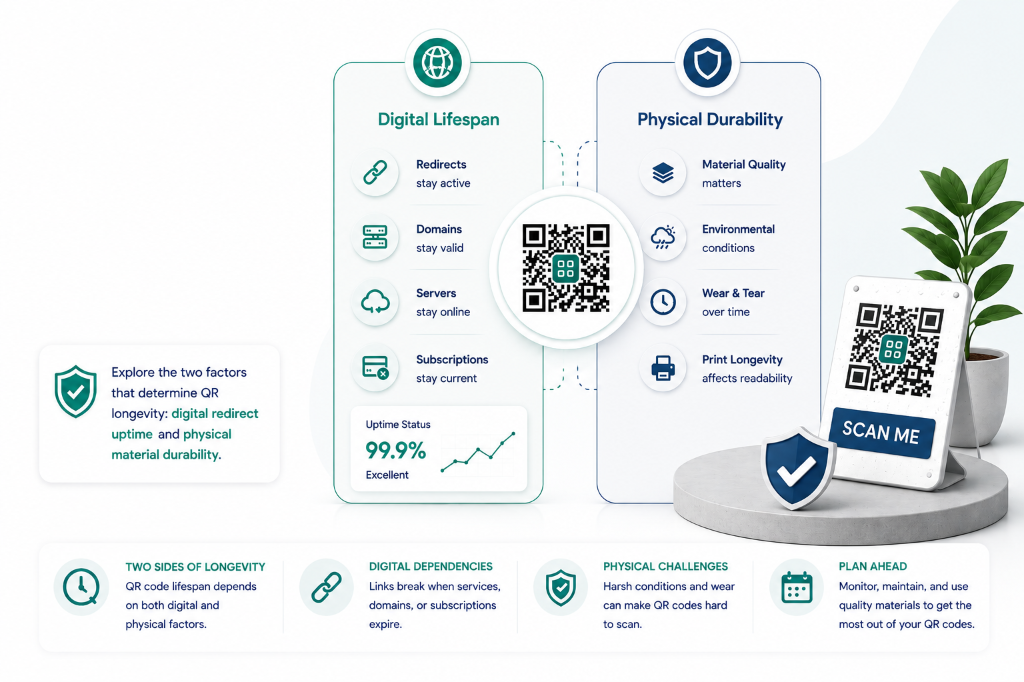
A common question from business owners, print buyers, and packaging engineers is: how long do QR codes last? The answer is that a QR code has no universal expiration date. Instead, its operational lifespan is determined by two independent dimensions: its physical durability on a printed surface and its digital availability across the web.
A scan remains functional only as long as both dimensions hold true: the physical symbol must remain optically scannable by a camera sensor, and the digital destination—including any intermediary redirect service—must remain active and accessible on the internet.
Quick Answer
How Long Do They Last?
Indefinitely — under the right physical and digital conditions.
The visual symbol itself never expires. Its functional lifespan depends on substrate durability and redirect domain/server uptime.
Longevity by Architecture:
- Static QR: Indefinite (Fixed link)
- SaaS Dynamic: Subscription-limited
- Permanent Dynamic: Indefinite (Pay-Once)
01 What Determines a QR Code's Lifespan?
To evaluate how long a QR code will remain usable in production, you must analyze its two foundational lifespans: Digital Lifespan and Physical Lifespan.
Digital Lifespan
The digital lifespan represents the continuity of the resolution chain connecting a scan to the final landing page. This requires active domain registration, valid SSL/TLS certificates, and web servers responding with HTTP 200 codes.
Physical Lifespan
The physical lifespan represents how long the printed symbol retains sufficient optical contrast and geometric precision for camera sensors to decode its modules, depending on materials, ink, UV, and handling.
02 How Long Do Static QR Codes Last?
Static QR codes encode their payload directly into the visual modules without routing through an intermediary gateway. Because no third-party vendor sits in the resolution path, static QR codes have an indefinite digital lifespan—they cannot be turned off by an external company, and they carry zero ongoing fees.
However, a static QR code's lifespan is inextricably tied to the permanence of the exact destination URL encoded into it. If your company rebrands, updates website CMS structures, or deletes the target page, the printed static code becomes a permanent dead end.
03 How Long Do Dynamic QR Codes Last?
Dynamic QR codes route scans through a short intermediary redirect URL. This architecture allows you to update the destination URL anytime in a management dashboard without changing the printed symbol. However, this flexibility introduces an operational dependency on the redirect infrastructure.
On traditional SaaS platforms, dynamic QR codes last only as long as you maintain an active monthly or annual billing plan ($10–$50/month). If an account is canceled or an invoice is missed, the provider disables the redirect. Permanent dynamic QR codes solve this by offering lifetime hosting with a single one-time payment ($49), ensuring redirects remain active indefinitely without recurring bills.
04 What Can Make a Printed QR Code Stop Working?
Even when digital servers are fully operational, physical wear and environmental exposure can degrade a QR code to the point of unreadability. The most common physical failure factors include:
Outdoor sunlight breaks down organic dye-based inks over time, reducing the luminance contrast between the dark modules and the background substrate.
Surface Scratches and Abrasions
High-contact surfaces (such as packaging, equipment tags, or table menus) suffer mechanical scratches that can obscure alignment patterns.
Moisture and Thermal Degradation
Standard paper and thermal receipt labels degrade rapidly when exposed to humidity, grease, or heat.
Encroachment on the Quiet Zone
The ISO standard requires a mandatory clear border (quiet zone) of at least 4 module widths around the symbol. Graphics bleeding into this border cause scanner failure.
Insufficient Print Resolution
Raster images printed below 300 DPI can produce blurry module edges, causing scan failures on budget smartphone cameras.
05 How QR Code Error Correction Helps
To protect printed barcodes from physical degradation, the ISO/IEC 18004 specification integrates Reed-Solomon mathematical error correction. This algorithm embeds redundant data blocks into the symbol, allowing optical decoders to reconstruct missing or damaged modules.
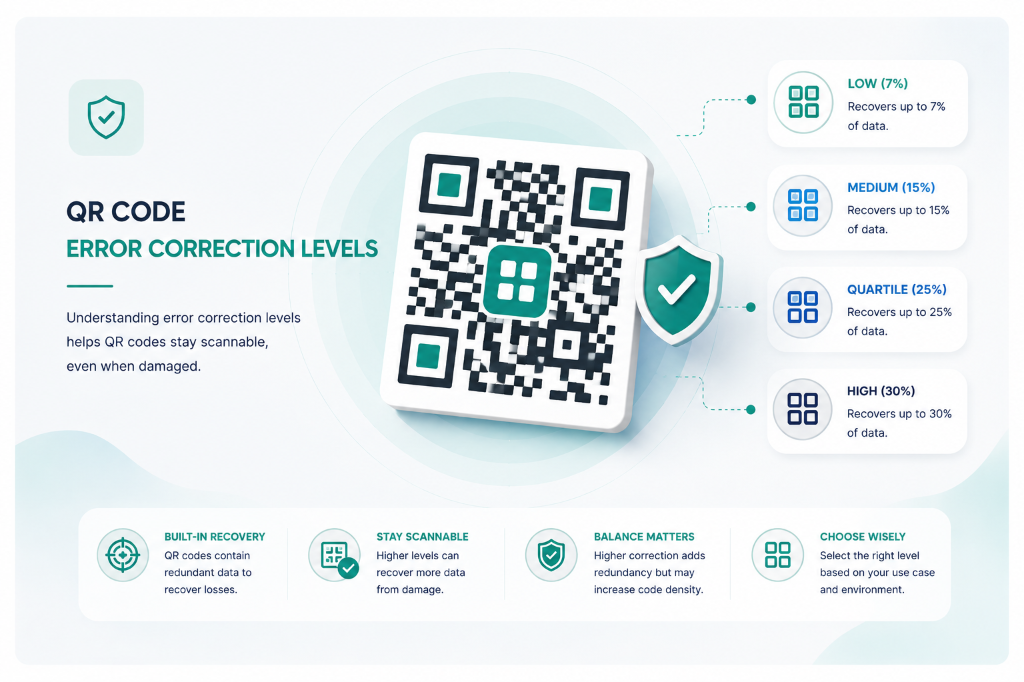
Recovers ~7%
Creates the cleanest, least dense matrix. Ideal for clean indoor retail packaging and tiny labels.
Recovers ~15%
The standard default for general marketing materials, flyers, brochures, and dynamic billboards.
Recovers ~25%
Suitable for environments with moderate handling, direct scuff risk, and light dust exposure.
Recovers ~30%
Maximizes physical durability. Essential for outdoor signage, industrial equipment tags, and monuments.
Higher error correction improves durability against physical scratches, but increases module density. For high-wear applications, combining Level H error correction with compact dynamic short links provides the optimal balance of durability and readability.
06 How to Make a QR Code Last as Long as Possible
To maximize the operational lifespan of your QR codes across both digital and physical dimensions, follow this engineering checklist:
Choose the Right Architecture
Choose the right architecture for your longevity requirements. Use free static codes for fixed offline data. For commercial print where content may change over years, use permanent dynamic codes with lifetime hosting.
Match Substrate to Environment
Match print substrates to your target deployment environment. Use laminated vinyl for multi-year outdoor signage, or anodized aluminum and laser-etched stainless steel for multi-decade industrial equipment and permanent memorials.
Export in Vector Formats
Export vector files for high resolution layout preservation. Always export in print-ready vector formats (SVG, PDF, EPS) so the barcode scales losslessly without pixelation.
Maintain High Contrast and Quiet Zones
Maintain quiet zones and contrast limits. Ensure dark modules sit on a clean, solid light background with at least 4 modules of unobstructed quiet zone margin.
Pre-Flight Scan Testing
Conduct pre-flight scan testing across multiple devices. Test physical print proofs across multiple smartphone generations under varying lighting angles before mass production.
07 Static vs Dynamic: Which Is Better for Long-Term Use?
The table below summarizes how static, traditional dynamic, and permanent dynamic QR codes compare across key longevity factors:
| Factor | Static QR Code | Subscription Dynamic | Permanent Dynamic |
|---|---|---|---|
| Digital Lifespan | Indefinite (Tied to URL) | Tied to monthly billing | Indefinite (Lifetime hosting) |
| Destination Flexibility | None (Cannot edit) | Full (Edit in dashboard) | Full (Edit in dashboard) |
| SaaS Cutoff Risk | Immune (No server) | High Risk (Lapses if unpaid) | Immune (One-time payment) |
| Physical Durability | Durability depends on physical print substrates and error correction levels, not the digital platform model. | ||
| Cost Over 5 Years | $0 | $600–$3,000+ in SaaS fees | $49 one-time payment |
| Best Long-Term Use | Fixed Wi-Fi, offline text | Short-term promo links | Packaging, signage, memorials, books |
Skip the $600–$3,000 in subscriptions. Get a permanent QR code for a one-time $49 payment.
See permanent QR pricing →08 Examples of Long-Term QR Code Use
Different commercial applications require tailored physical materials and digital hosting strategies to ensure multi-year reliability:
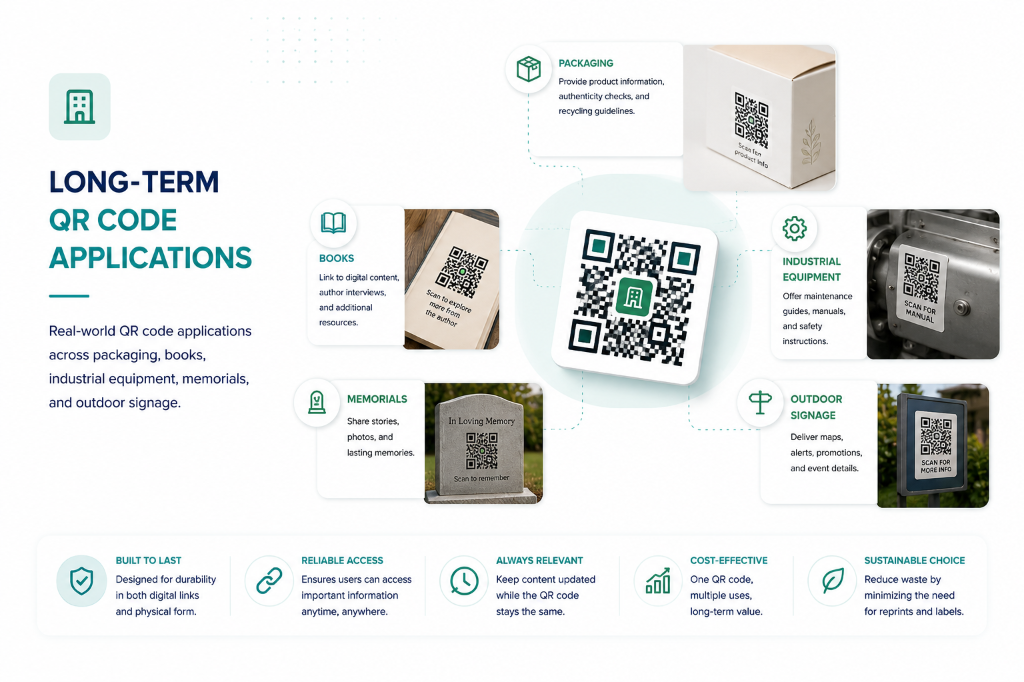
Product Packaging & Labels
A manufacturer may print a barcode on packaging that stays in warehouse storage or retail distribution for months or years before the product is used. The destination link needs to remain active throughout the product's entire lifecycle, while the printed label must survive abrasion, moisture, and temperature changes in storage.
What can go wrong: Static codes break permanently if the destination URL changes; subscription-based dynamic codes may stop working if the account lapses before the product clears inventory.
Recommendation: Use a permanent dynamic code so the destination can be updated if packaging resources change, and print on laminated or gloss-coated stock to protect against handling wear.
Books & Published Works
A printed book or magazine may remain in circulation for a decade or longer. Once printed, the physical barcode cannot be changed, so any digital link inside needs to stay live as long as readers can find the publication — in libraries, secondhand shops, or private collections.
What can go wrong: If a publisher's website is reorganised or closed, static codes become dead ends. A subscription-based redirect can expire years after publication if billing is discontinued.
Recommendation: Use a permanent dynamic code with lifetime hosting so the destination can be redirected to new URLs if the original page moves, without reprinting.
Industrial Machinery & Asset Tags
A code affixed to factory equipment may need to link to maintenance manuals, safety documentation, or service records for the entire operational life of that machine — potentially ten to twenty years. The label itself is exposed to grease, heat, vibration, and chemical cleaning agents.
What can go wrong: Paper or standard vinyl labels degrade quickly in industrial environments. If documentation is migrated to a new platform, static codes cannot be updated.
Recommendation: Use laser-etched anodized aluminum or stainless steel labels (Level H error correction) paired with a permanent dynamic code so service documentation URLs can be updated without relabelling equipment.
Memorials & Outdoor Signage
A bronze plaque, a cemetery memorial, or a heritage trail sign may display a scan for decades. Visitors expect the digital link to open relevant content — a biography, a historical record, or multimedia — regardless of when the scan occurs.
What can go wrong: UV exposure and rain degrade standard inks over time. If the hosting organisation changes its website or domain, the destination disappears permanently for static codes.
Recommendation: Engrave or laser-etch the matrix into durable metal or stone with Level H error correction, and use a permanent dynamic code so the archive destination can be maintained or transferred over time without physical replacement.
FAQ & Clarifications · 09
Frequently Asked Questions
Answers to common questions about QR code lifespan, physical durability, and redirect uptime.